A scene from your world
The line of the next pass
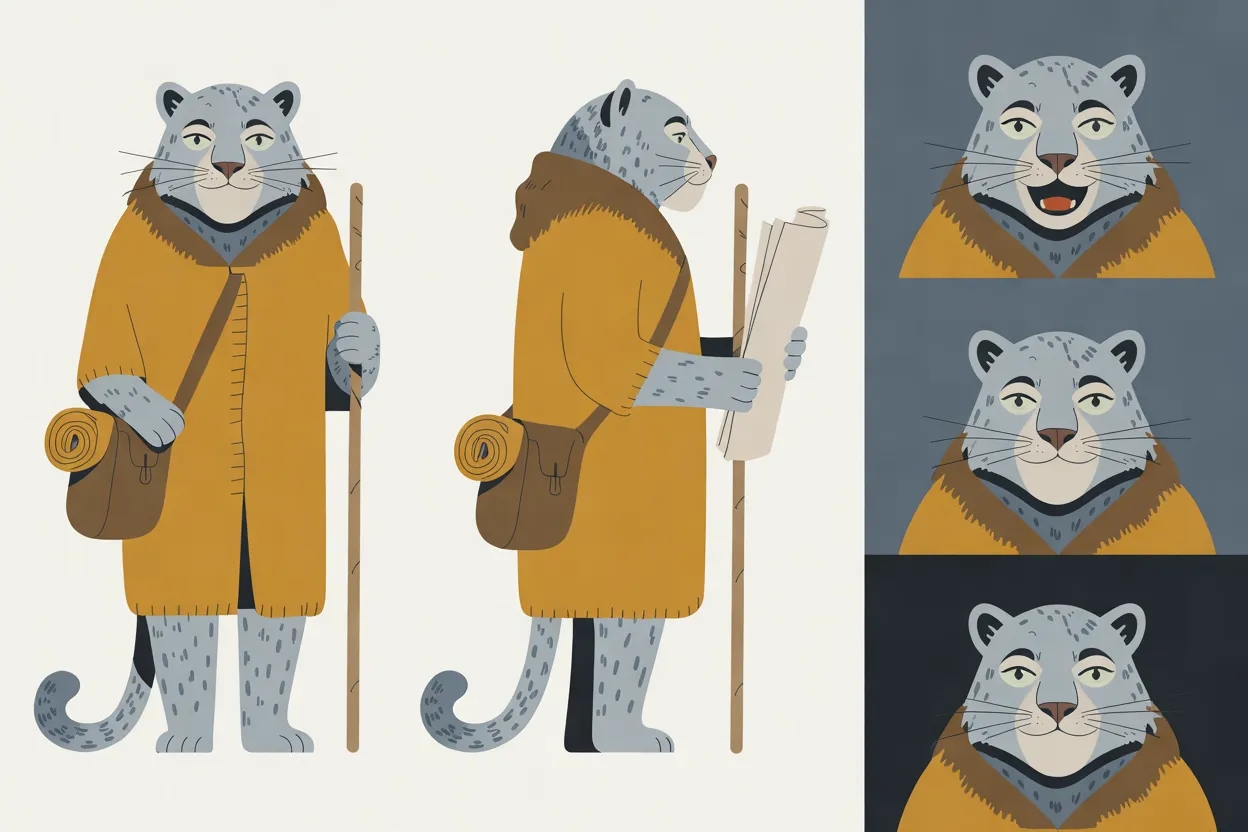
The path forks on the high pass, as paths do, and the Mountain Elder stops there, as elders do, and unrolls a map. The map is older than the path. It is older than most of the passes it describes. The Elder reads it anyway, not because it is right but because reading it is how you find out how it is wrong, and leans on the walnut staff, worn smooth where the paw goes, and looks up.
Up is where the lines are. On this pass the contour lines have left the maps and drift across the sky, long slow curves of them, bending round the peaks the way water bends round stones. The Elder reads them the way other travellers read weather. When the lines bunch together over a col, the climb is steep. When they spread, there is a meadow, or there was one once.
A young goat comes up the path at a run, which is the only speed the young have, and stops in a scatter of grit. “Which way is faster?” “Faster to where?” The goat has not thought about where. The Elder waits, which is the kindest thing anyone has done for the goat in a week, and then sits down on the ledge, which is the second kindest, and pats the stone alongside.
They sit. The Elder points the staff at the left fork, then at the lines over it, which are packed tight as the rings of a tree; then at the right fork, where the lines open out and wander and take their time. “That one is faster,” says the Elder, “and that one gets there.” The goat looks at the lines for a long time. Learning to look at the lines is the whole education; everything after that is walking.
They take the right fork, together, at the Elder’s pace, which the goat finds unbearable for the first hour and then stops noticing. At the top of the pass there is nothing on the map. The Elder unrolls it on a flat stone, takes a pencil from the satchel, and draws the way they came: one new line, careful, a little crooked where the goat had insisted on a shortcut that wasn’t.
“Now it’s on the map,” says the goat. “Now it’s on the map,” the Elder agrees, and rolls it up with the others, and looks at the next pass for as long as it takes, which is the part of the day the Elder likes best, and which the goat, in a few years, will understand.